Most of us live in a quiet state of alert: notifications, deadlines, a mind that keeps running long after the day ends. Sound healing has become one of the most popular ways to step out of it. But why does lying down with gongs and crystal bowls leave people feeling so much calmer? The answer lies in three things research understands well: breath, deep rest and attention.
Why stress lives in the body
Stress isn’t only a thought. When we feel under pressure, the body shifts into “fight or flight”: the heart beats faster, breathing becomes shallow, and muscles stay tense. In short bursts, this keeps us sharp. Kept on for weeks, it shows up as tension, restlessness, a racing mind and poor sleep.
The opposite state, often called “rest and digest”, is where the body recovers. A good sound healing session is designed to guide you there, first through the body, then the mind.
Breath: the strongest science
Of everything that happens in a session, slow breathing has the most research behind it. Breathing at around six breaths a minute brings heart rhythm and blood pressure into a calmer, more balanced pattern.
A review of 223 studies found that slow breathing increases heart rate variability, a well-established marker of the body shifting towards rest, during practice, immediately after it, and over weeks of regular practice (Laborde et al., 2022).
The effect goes beyond the heart. Across 12 randomized trials and 785 people, breathwork reduced stress, with similar improvements in anxiety and low mood (Fincham et al., 2023).
Chanting and mantra naturally bring the breath to this pace. A study in the BMJ found that reciting a mantra slowed breathing to around six breaths per minute on its own and improved the body's ability to steady blood pressure (Bernardi et al., 2001). This is one reason the closing Kundalini meditation in a Resonance session is so settling
Sound: rest without effort
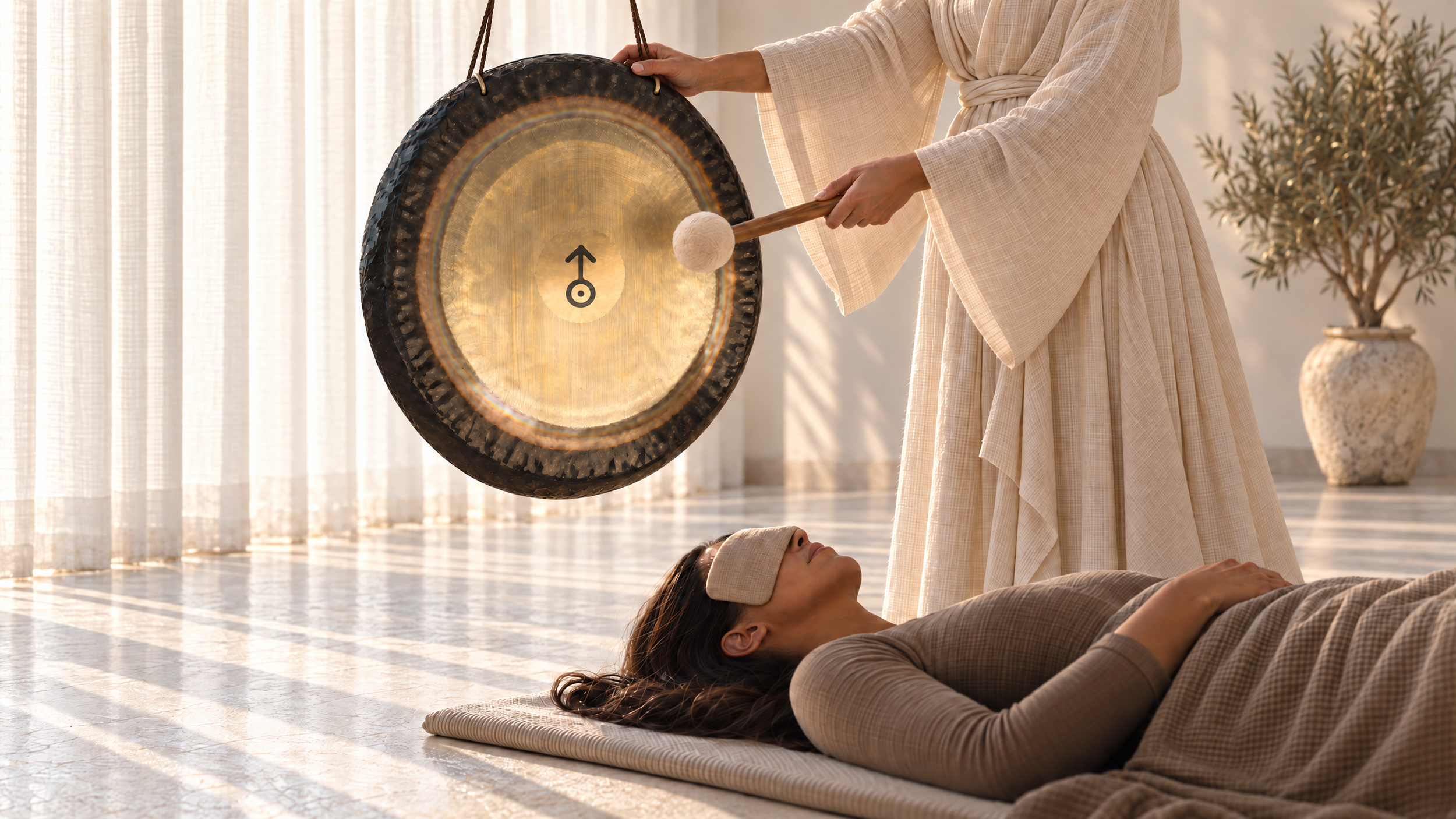
When you lie down, and the gongs and crystal bowls begin, there is nothing you need to do. Instead of trying to stop your thoughts, you listen, and the mind settles on its own.
Research is beginning to show why. Repeating even a single word quietly reduces activity in the brain’s “default mode network”, the network most active when the mind wanders, replays the past or rehearses the future (Berkovich-Ohana et al., 2015). A steady sound appears to play a similar role.
Studies of sound meditation itself are growing:
• In a trial of 50 adults with anxiety, a single singing bowl session reduced anxiety and improved heart rate variability (Rio-Alamos et al., 2023).
• In a study of 62 adults, one singing bowl meditation significantly reduced tension, anger, fatigue and low mood, and people new to this kind of meditation felt the biggest drop in tension (Goldsby et al., 2017).
• In a trial of 100 adults, four weeks of sound meditation with singing bowls, gongs and bells reduced anxiety, low mood, blood pressure and the stress hormone cortisol, more than listening to music (Ravikumar et al., 2026)
Sound also does something no recording can: in a live session, you feel the vibration of the gong and bowls through your body as well as hearing it, which many people describe as the moment they finally let go.
Why sound healing can help you sleep more deeply
Better sleep is one of the most common things people mention after a session. Research supports the practices behind it: in a trial of 40 adults with insomnia, eight weeks of daily Kundalini practice helped people fall asleep faster, sleep longer, and sleep more efficiently than sleep-hygiene advice alone (Khalsa & Goldstein, 2021).
Sound healing itself is still being studied for its effects on sleep. What we see in practice is simple: a calmer body and a quieter mind make it easier to wind down, and many people tell us they sleep better on the night of a session.
Why your first session can feel so powerful
People often describe a gentle “high” after a session: lightness, clarity, a soft buzz through the body. In a Resonance session, it comes from three things. The dynamic breathing at the start changes the balance of oxygen and carbon dioxide in your blood, which is why you may feel tingling or a rush of energy.
Then the gongs and crystal bowls take over: you hear the long tones and feel their vibration through the floor and your body, and your heart rate and breathing begin to slow. Finally, the closing meditation changes from session to session, sometimes calming, sometimes energizing, but always leads the mind into stillness.
Frequently asked questions
Does sound healing help with anxiety?
Research is encouraging. Studies of sound meditation report reduced anxiety and tension, and a large trial found Kundalini Yoga helped more than half of adults with generalized anxiety. It works best as a complement to care from your doctor or therapist.
Can sound healing help me sleep better?
Many people report sleeping more deeply after a sound healing session. As the gongs and crystal bowls slow the mind's pace, the body settles into rest, making it easier to wind down that night.
In a Resonance session, sound is paired with Kundalini practice, which research shows can help people fall asleep faster and sleep longer, so the calm you feel continues well into your evening.
Is there science behind sound healing?
Yes. Studies of sound meditation with gongs and singing bowls show reduced tension, anxiety, fatigue, and low mood, as well as a calmer heart rhythm, with some effects evident after just one session.
In a Resonance session, the effect is supported by Kundalini breathwork and meditation, practices with strong research supporting their ability to reduce stress and anxiety.
How often should I do sound healing for stress?
There is no fixed rule. Some people come for a monthly reset; others make it a weekly ritual. Regular practice tends to make it easier to reach deep rest each time.
Is sound healing a medical treatment?
No. Sound healing supports relaxation and wellbeing and does not replace medical or psychological care. If you have a health condition, speak to your doctor before attending.
Ready to feel the difference for yourself? Choose your journey, and we’ll reply within 24 hours.